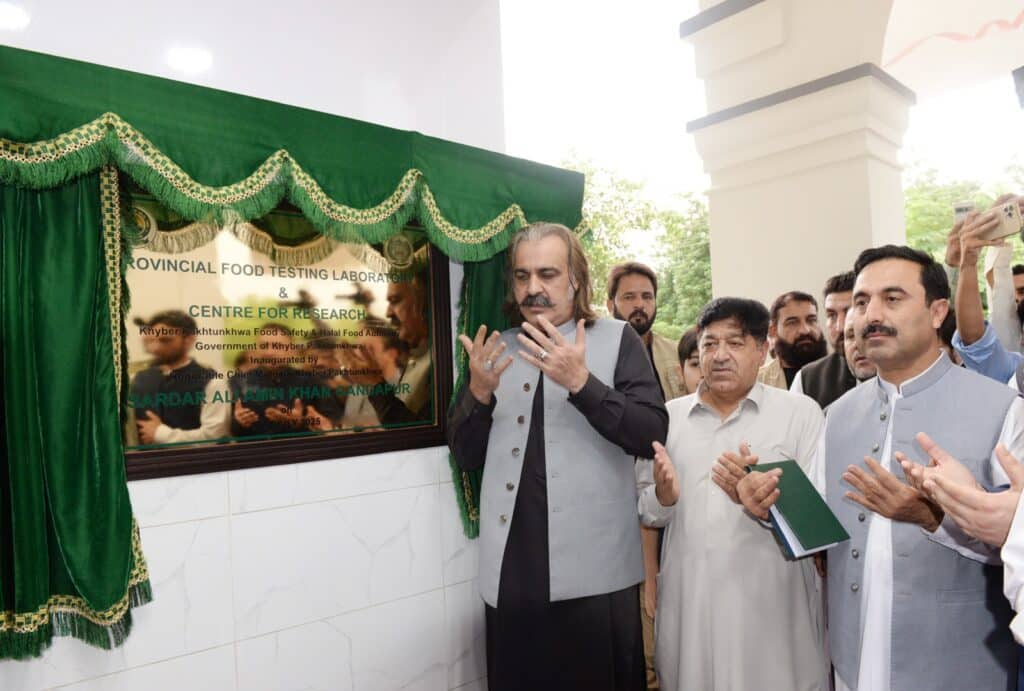
Chief Minister Khyber Pakhtunkhwa Ali Amin Khan Gandapur on Wednesday inaugurated the province’s first state-of-the-art Provincial Food Testing Laboratory and Centre for Research in Hayatabad, Peshawar — a major step toward ensuring food safety and public health.
Established for Rs905 million under the administrative control of the Khyber Pakhtunkhwa Food Safety and Halal Food Authority (KPFS&HFA), the facility is built to ISO standards. It aims to revolutionise the way food is tested, monitored, and regulated across the province. Minister for Food Zahir Shah Toru, Advisor to CM for Relief Naik Muhammad, Secretary Food, Secretary C&W, DG Food Authority and other officials were also present on the occasion.
The laboratory comprises eight specialised units under one roof, supported by a centralised Management Information System (MIS) and a digital traceability system. The system is designed to ensure transparency and faster access to lab reports for consumers and food businesses alike.
According to Food Minister Zahir Shah Toru, the facility is equipped to test around 1,500 parameters across 100 categories of food and beverages. “This lab is a game-changer in the food safety landscape. We no longer need to rely on other provinces or private labs for testing. This will significantly improve the quality of food available to the public,” the minister remarked.
He added that the lab would also play a key role in guiding the food industry, strengthening R&D efforts, and supporting evidence-based policymaking.
The provincial laboratory is also integrated with the Authority’s field operations in more than 20 districts, where teams are tasked with collecting samples. This network ensures the timely and secure transportation of samples to the lab for detailed analysis.
The data collected from food samples across the province will not only assist the KPFS&HFA in enhancing food quality and safety, but will also serve as a scientifically backed resource for other key departments. These include Public Health, Local Government, Agriculture, Livestock & Fisheries, and the Health Department, helping them identify preventive healthcare markers. Moreover, departments like Industry, Environment, and the Environmental Protection Agency (EPA) can use this data to trace sources of adulteration and identify non-compliant units. The Authority aims to build strong interdepartmental synergies, ensuring efforts are not duplicated but instead complemented, positioning itself as a support mechanism for all relevant departments
Furthermore, The laboratory offers an extensive range of food testing services, including: microbiological analysis for detection of harmful pathogens such as Salmonella, E. coli, Listeria, , and moulds, Chemical analysis for detecting food adulteration, artificial colouring, preservatives, and toxic compounds such as, aflatoxins, and famaline, and nutritional testing to determine the presence of fat, protein, moisture, ash, and calorific value.
The laboratory also offers advanced testing services, including the detection of antibiotic residues in milk and meat. It facilitates Halal certification and meat speciation to identify non-permissible species such as pork, donkey, or dog meat.
In addition, the lab is capable of detecting heavy metals in water and beverages, etc. and pesticidal residues in fruits and vegetables.
Read also: PESCO Peshawar rejects new load schedule amid security fears
Furthermore, the lab is equipped with cutting-edge technologies, including Gas Chromatography–Mass Spectrometry (GC-MS), Atomic Absorption Spectroscopy (AAS), Inductively Coupled Plasma–Optical Emission Spectroscopy (ICP-OES), High-Performance and Ultra High-Performance Liquid Chromatography (HPLC & UHPLC), and Fourier Transform Infrared Spectroscopy (FTIR).
Director General KP Food Safety & Halal Food Authority, Wasif Saeed, while briefing, said: “We are deeply thankful to the Honourable Chief Minister and the Minister for Food for their tremendous support and vision in making this vital project a reality. The successful and timely completion of the lab reflects the provincial government’s commitment to safe, healthy food for the people of Khyber Pakhtunkhwa.”